|
ORIGINAL ARTICLE |
|
Transpedicular
Approach To Dorso-Lumbar
Spine Injuries
|
|
Arjun
Shetty*, Sandeep S, Ireshanavar**
*Consultant
Neurosurgeon
**Registrar In Orthopaedics, Tejasvini Hospital,
Mangalore, India.
Address for Correspondence
Dr Arjun Shetty
Consultant Neurosurgeon,
Tejasvini Hospital And SSIOT,
Kadri, Mangalore ,
Karnataka
Fax : 0824
2225998
drsandeepsi25@Yahoo.com
|
|
Abstract
Over a period of 2 years
thirty-seven patients with dorso-lumbar spine injuries were
operated using the transpedicular approach. This approach
provides adequate cord decompression which was confirmed using
an endoscope. Fusion using iliac crest graft and stabilisation
with transpedicular screws and plates were done through the same
approach. Of the cases treated there was no mortality. One
patient had implant failure while two cases had infection of the
graft donor site.
Key
words: Thoraco-lumbar spine; transpedicular approach;
endoscope.
J.Orthopaedics 2007;4(2)e8
Introduction:
Thoraco-lumbar spine injuries can be operated
through a number of approaches. The posterior decompressive
laminectomy has fallen out of favour with reports now suggesting
that neurological deterioration could result following the
procedure1,2,3. The anterior approach allows for excellent
exposure of the vertebral body. However the procedure is
associated with significant post-operative morbidity and a
second procedure may be needed for posterior stabilization of
the spine4. The transpedicular approach allows for a single
stage vertebral body decompression, graft placement and
fixation. The procedure is cost effective and allows early
mobilisation of patients.
Material and Methods :
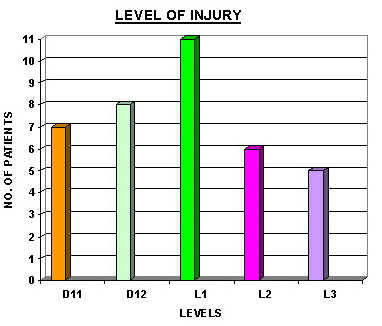
Thirty-seven patients with
thoraco-lumbar spine injuries involving D11 vertebrae and below
were operated via the transpedicular route over a period of two
years. Of these four were female and thirty-three were male. The
patient’s age ranged from 17 to 62 years (average age 39
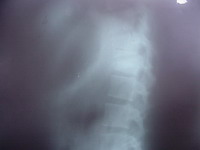
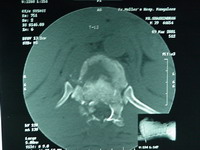
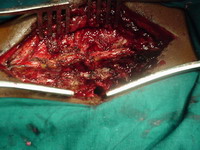
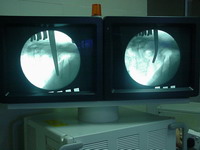
years).[FIGURE I]
Nine patients had no neurological deficit. Of the remaining,
twelve presented with paraplegia and sixteen with paraparesis.
Bladder and bowel involvement was noted in twenty-three patients
and twenty-six patients had diminished sensory perception.
Seventeen patients had associated orthopaedic injuries while
three had chest injuries and two patients had abdominal injuries
which necessitated surgical exploration.
All patients were
investigated with radiographs and CT scans. Eight patients with
no neurological deficit and three patients with neurological
deficit were noted to have no evidence of cord compression. In
the three who had neurological deficit the absence of cord
compression was confirmed with an MRI.
All eleven patients who had
no evidence of cord compression were stabilised using
transpedicular screws and plates5. All twenty-six patients who
had evidence of cord compression were subjected to
transpedicular decompression. A fibre optic nasal endoscope was
used to confirm adequate decompression on table6. In
twenty-three cases iliac crest grafts were used for fusion. All
twenty-six patients were stabilised using transpedicular screws
and plates.
Results :
All nine patients who
presented without neurological deficits remained neurologically
intact after surgery and could be mobilised on a thoraco-lumbar
brace.
Of the twelve patients who presented with complete
paraplegia, four patients improved enough to achieve
mobilisation with callipers and a single crutch. Six patients
were mobilised on callipers and two crutches using a swing
through gait. Two patients could not be mobilised on callipers
and remained wheel-chair bound on discharge.
Seven out of the sixteen
patients who presented with paraparesis improved sufficiently to
allow mobilisation on a thoraco-lumbar brace. Six patients could
be mobilised on callipers and a single crutch. Two patients were
mobilised on two crutches using swing through gait. One patient
could not be mobilised on callipers and was wheel-chair bound on
discharge.
The duration of hospital stay varied form fifteen to
sixty-three days (average twenty-eight days). There was no
mortality in this series of patients. One patient had an implant
failure which necesstated the removal of the implant. Two
patients developed infection at the donor graft site which
responded to antibiotics. Sixteen patients developed bedsores,
all of which could be managed conservatively.
|
|
|
|
|
|
|
|
|
|
Discussion :
Decompressive laminectomy
has fallen out of favour as a treatment option in thoraco-lumbar
spine injuries as it does not relieve the primary compression
and also further increases instability. The damage to the
already oedematous cord may be worsened during the
procedure1,3,7,8.
The anterior approach provides excellent visualisation of
thoraco-lumbar vertebral body. However the exposure is
associated with some morbidity and entails venturing into areas
not routinely accessed by neurosurgeons. Stabilisation through
the anterior approach requires the use of stabilisation devices
which are expensive and not manufactured locally at
present4,9,10.
The transpedicular approach allows for vertebral body
decompression, fusion and fixation through a single area of
access with minimal morbidity. The functional recovery seen with
this procedure are comparable with other procedures2,7,11.
The transpedicular approach
however does have certain drawbacks. Decompression is a tedious
process and there is a possibility of a compressive fragment
being left behind. We have tried to overcome this by using a
flexible fibre optic nasal endoscope to directly visualise the
fragments6. We have had some success with this technique.
However bleeding from the bone may limit visibility in some
cases.
We have found the
transpedicular decompression and fixation to be technically
difficult in injuries above the tenth thoracic vertebrae. In
lesions above this level we have used the anterior approach for
decompression and fixation.
The thoraco-lumbar transpedicular approach
allows good decompression, fusion and fixation to be done as a
single procedure. It is associated with minimal morbidity and
allows rapid cost effective mobilisation of these patients.
Reference :
-
Erickson D.L., Hancook D.O. Brown W.E. et al.: One stage decompression, stabilisation
for thoraco-lumbar fractures. Spine 1977 2: 53-56.
-
Frankel H.L., Hancock D.O., Hyslop G. et al: The value of
postural reduction in the initial management of closed spine
injuries with paraplegia and tetraplegia. Paraplegia 1969: 7:
179-192.
-
Jelsma R.K., Rice J.F., Jelsma L.F. et al: The
demonstration and significance of neural compression after
spinal surgery. Surg. Neurology 1982: 18: 79-92.
-
Cook W.A. Jr., Hardaker W.T. Jr.: Injuries to the
thoracic and lumbar spine. In Wilkins R.H., Rengachary S.S. (eds),
Neurosurgery Vol II McGraw Hill, 1996. pp 2987-2995.
-
Steffe A.D., Biscup R.S., Sitteroski D.J.: Segmental
spine plates with pedicle screw fixation: a new internal
fixation device for disorders of the lumbar and thoraco-lumbar
spine. Clin. Orthop. 1986: 203: 45-53.
-
Le Roux P.D., Haglund M.M., Harris A.B.: Thoracic disc
disease experience with transpedicular approach in twenty
consecutive patients. Neurosurgery 1993 33(1): 58-66.
-
Benzel E.C., Larsen S.J.: Functional recovery after decompressive operation for thoracic and lumber spine fractures.
Neurosurgery 1986 19: 772-778.
-
Guttman L.: The conservative management of closed
injuries of the vertebral column resulting in damage to the
spinal cord and spinal roots. In Vinken P.J., Bruyn G.W. (eds):
Handbook of clinical neurology, Vol 26. New York: American
Elsevier, 1976 pp 285-306.
-
Kaneda K: Anterior spinal instrumentation for the
thoracic and lumbar spine. In An. H.S. Cotter J.M. (eds): Spinal
instrumentation. Baltimore: Williams and Wilkins, 1992 pp
413-433.
-
Yuan H.A., Mann K.A. Found E.M. et al: Early clinical
experience with the Syracuse I plate an anterior spinal fixation
device. Spine 1988 13: 278-285.
-
Jelsma R.K., Kirsh P.T., Jelsma L.F. et al: Surgical
treatment of thoracolumbar fractures. Surg. Neurology 1982
18:156-166.
|
|
This is a peer reviewed paper Please cite as
:Arjun Shetty: Transpedicular
Approach To Dorso-Lumbar
Spine Injuries
J.Orthopaedics 2007;4(2)e8
URL:
http://www.jortho.org/2007/4/2/e8 |
|
|
ANNOUNCEMENTS |
 |
|

|
|
|
|
Arthrocon 2009
International Symposia on
Arthroplasty and Arthroscopy
Hands on Workshop, Case Discussions
Interactive Sessions
with
International Faculty
April 26,
2009
At Port City of Calicut, Kerala, India
"Download
Registration Form"
For Registration
Dr Sibin Surendran,
Dept of Orthopaedics,
Medical College,
Calicut,
Kerala, India
Ph:+91 9447636977
E-Mail:
drsibins@rediffmail.com
|
|
Powered by
VirtualMedOnline |
|